
When an ACL Fails: A Revision Case and What the MARS Study Taught Us
Most failed ACLs have more than one cause. A real revision case — a forward femoral tunnel, a stretched allograft and torn menisci — and what the MARS study says about fixing all three.
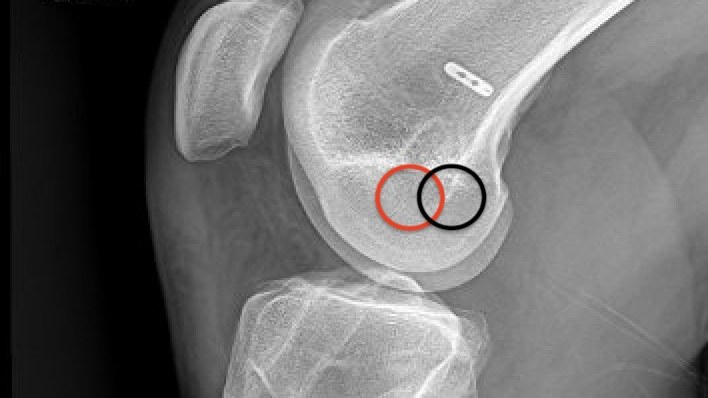
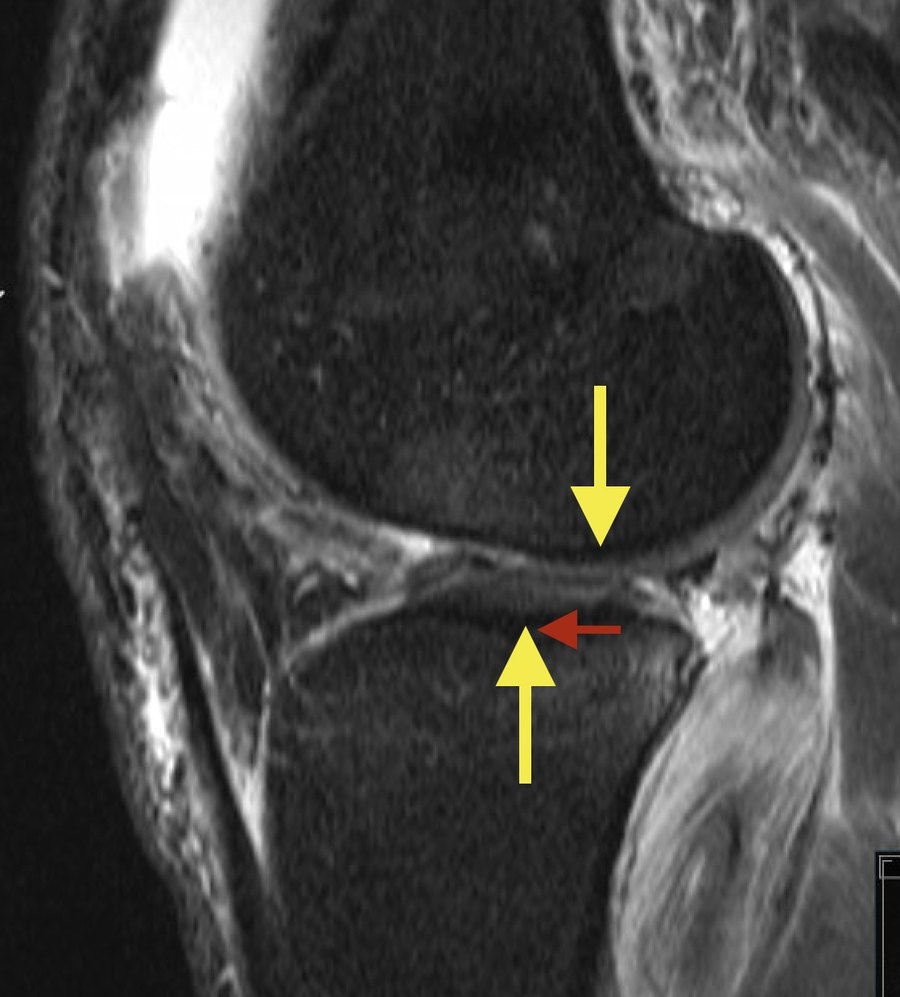
I recently did a revision ACL reconstruction on a patient in their early 30s. Their first ACL reconstruction was done in their early 20s, using a donor tendon (an allograft). Over the following decade that graft stretched out, the knee slowly got looser, and a re-injury eventually tore both the medial and lateral meniscus.
When I looked at the imaging, it wasn't one problem. It was three. And that is exactly the lesson the largest study of revision ACL surgery ever done has been teaching us for years.
What the MARS study is
The Multicenter ACL Revision Study (MARS) followed more than 1,200 patients having revision ACL surgery, performed by 83 surgeons at 52 sites2. When the revising surgeons were asked why the first graft failed, the answer was usually not a single cause1.
MARS sorts failures into traumatic (a new injury), technical (a surgical issue, like tunnel position), and biologic (the graft never incorporated or stretched out). My patient had all three.
Three problems in one knee
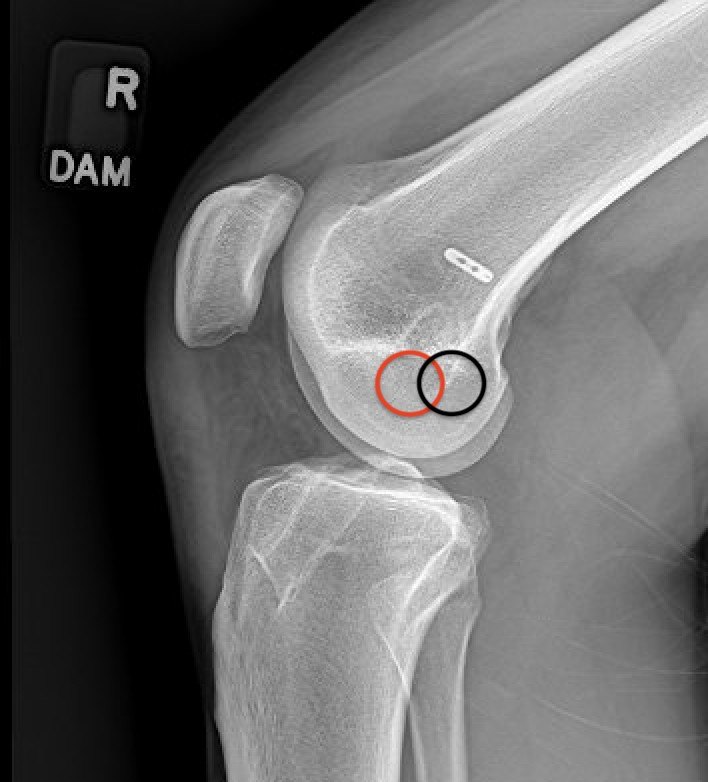
Technical: The femoral tunnel was too far forward. This is the most common technical error MARS found, and it's one I see regularly in failed ACLs. A vertical graft can look fine on MRI and still not control the knee.
Biologic: A donor graft has to be slowly remodeled by your body. In someone young and active, as this patient was at their first surgery, that process doesn't always keep up. Combined with a poorly positioned tunnel, this graft gradually stretched, and the tibia drifted forward and stayed there.
Traumatic: The final re-injury happened on a knee that was already loose. The menisci had been acting as the backup ACL, and they paid the price. The re-injury was the last straw, not the whole story.
Why I did this in two stages
As you can see on the X-ray, the old tunnel overlaps where the new one needs to go. You can't reliably drill a good tunnel into a hole that's already there. So at the first surgery, I removed the old graft and bone grafted the tunnels. I also added a lateral extra-articular tenodesis (LET), a small reinforcement on the outside of the knee that helps control the rotational instability these knees almost always have.
Once the bone graft healed, I did the second stage: a new ACL in the anatomic position, using the patient's own tissue.
To be honest about the tradeoffs: in MARS, patients who needed two-stage bone grafting had lower knee scores at two years than patients who didn't need grafting3. That isn't because staging is harmful. It's because those knees are more damaged to begin with. I stage a revision when a single surgery can't put the tunnel in the right place, not for convenience.
Why autograft the second time
MARS was clear on this one. At two years, autograft patients were 2.78 times less likely to re-rupture and had better sports function scores2. At six years, re-rupture was 3.5% with autograft versus 8.4% with allograft, and autograft patients needed fewer reoperations4. For an active patient with decades of use ahead of their knee, I want their own tissue at revision.
What recovery looks like
A staged revision is a longer road. After the second stage, I generally plan on 9 to 14 months before return to sport, and I clear patients on strength and hop testing, not the calendar. The goal isn't just getting back on the field. It's protecting the meniscus and cartilage that are left, for the next 50 years.
Had an ACL fail?
If your knee has given out again after ACL surgery, or never felt stable in the first place, come see me. Whether I did your first surgery or someone else did, we'll sort out why it failed and build a plan that fixes the cause, not just the tear.
References
- MARS Group. Descriptive epidemiology of the Multicenter ACL Revision Study (MARS) cohort. American Journal of Sports Medicine. 38(10):1979–1986. doi:10.1177/0363546510378645. PMID 20889962
- MARS Group; Wright RW, Huston LJ, Haas AK, et al. Effect of graft choice on the outcome of revision anterior cruciate ligament reconstruction in the Multicenter ACL Revision Study (MARS) cohort. American Journal of Sports Medicine. 42(10):2301–2310. doi:10.1177/0363546514549005
- MARS Group; DeFroda SF, Owens BD, Wright RW, et al. Descriptive characteristics and outcomes of patients undergoing revision anterior cruciate ligament reconstruction with and without tunnel bone grafting. American Journal of Sports Medicine. 50(9). doi:10.1177/03635465221104470. PMID 35833922
- MARS Group; Wright RW, Huston LJ, Haas AK, et al. Association between graft choice and 6-year outcomes of revision anterior cruciate ligament reconstruction in the MARS cohort. American Journal of Sports Medicine. 49(10). doi:10.1177/03635465211027170. PMID 34260326
This article is general education, not medical advice for your situation. Every knee and hip is different — talk with your own doctor about your care.