
The Knee Ligament That Usually Heals Itself: What Dallas Goedert's Injury Teaches Us About the MCL
Most MCL tears heal without surgery. Why the MCL is different from the ACL, realistic return-to-sport timelines by grade, and the few situations where I do operate.
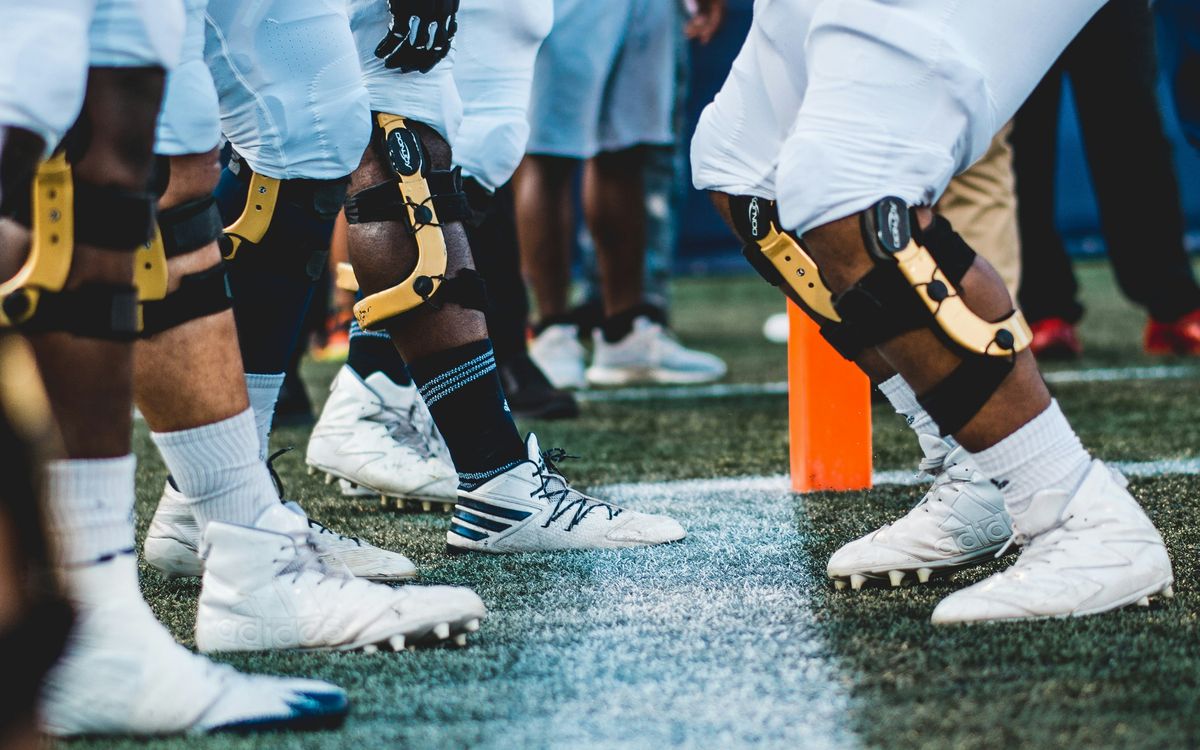
If you watched the Eagles play the Titans, you saw Dallas Goedert go down while blocking. His foot was planted, a defender drove into the outside of his leg, and his knee bent inward. That inward bend, what we call a valgus force, is the classic mechanism for a medial collateral ligament (MCL) injury.
The Eagles have called it a knee sprain, and the early word from people who study NFL injuries is that he avoided a major structural injury. I'm not his doctor, so I can't tell you exactly what's in his knee. But I can tell you what that kind of hit usually does, because I see the same injury in my clinic almost every week: a skier who caught an edge, a soccer player who got hit from the side, a guy who slipped on wet stairs. I even had a grade II MCL myself, snowboarding into a tree. These are common!
Here is the part most patients don't expect to hear from a surgeon: the MCL is the one major knee ligament that usually heals on its own. Understanding why, and knowing when that rule doesn't apply, is the whole story.
Why the MCL is different from the ACL
The MCL runs along the inside of the knee, from the femur to the tibia, and its job is to stop the knee from bending inward. Unlike the ACL, it sits outside the joint capsule, wrapped in soft tissue with a rich blood supply. When it tears, it bleeds, forms a clot, and lays down new collagen, the same way a cut on your skin heals.
The ACL lives inside the joint, bathed in joint fluid, and the torn ends never get that chance. That single anatomic difference is why I reconstruct approximately 85 ACLs a year and operate on only a small handful of MCLs.
MCL injuries are graded by how much the ligament stretched or tore and how loose the knee is when I stress it in the exam room:
- Grade I is a stretch with minimal looseness.
- Grade II is a partial tear with some looseness but a firm endpoint.
- Grade III is a complete tear where the knee opens up with no endpoint.
The grade drives everything about treatment and timeline.
What recovery actually looks like
Those numbers come from studies of professional athletes with full-time rehab teams, so I tell my patients to add a little cushion. But the pattern holds for weekend athletes too.
A Grade I sprain is a nuisance. A Grade II is a few weeks in a hinged brace with early motion and steady strengthening. Even a complete Grade III tear, if the MCL is the only thing injured, heals well enough without surgery in the large majority of people. In a three-season study of elite European soccer players, nearly every isolated MCL injury was managed without an operation, and the players came back.1
My non-surgical MCL protocol
- Hinged brace to protect against side-to-side stress — but I want the knee bending right away, because stiffness is the real enemy.
- Weight bearing as tolerated.
- Quad and hamstring work from the first week.
- Return to running once the knee is stable on exam.
- Return to cutting sports once strength is symmetric and the athlete trusts the knee.
I don't rush the last step, because a knee that is still loose when you go back tends to get hurt again.
When the MCL does need surgery
| Situation | Usual approach | Why |
|---|---|---|
| Isolated Grade I or II tear | Brace + rehab, no surgery | Heals reliably with a good blood supply |
| Isolated Grade III tear near the femur | Brace + rehab, surgery rarely needed | Proximal tears heal well; healing is checked on exam over 6 weeks |
| Grade III tear pulled off the tibia (distal) | Early repair often recommended | Distal tears can flip out of position and heal poorly |
| ACL + MCL torn together | Brace first, then ACL reconstruction; MCL fixed only if still loose | Most MCLs heal during the pre-op period; persistent looseness puts the new ACL at risk |
| Chronic looseness after 6+ weeks of rehab | MCL reconstruction | A ligament that never tightened up won't fix itself later |
The exceptions matter, and they're where a careful exam and a good MRI earn their keep. A distal MCL tear, where the ligament tears off the tibia, can fold over the hamstring tendons so that the torn end has nothing to heal to. Those I usually repair early.5
Multi-ligament injuries, especially ACL plus MCL, are the most common two-ligament pattern I see. The modern approach is to brace the knee and let the MCL heal first, then reconstruct the ACL a few weeks later.4 In a recent systematic review of combined ACL and MCL reconstructions, persistent looseness after at least six weeks of non-operative care was the reason for MCL surgery in over 80 percent of cases.3 In other words, we give the ligament every chance to heal itself and only step in when it hasn't.
That is the honest picture. Surgery for an MCL is the minority path, and when I do recommend it, it's because the anatomy of the tear or the company it keeps has taken away the ligament's ability to heal on its own.
Who I talk to about this
Anyone with a valgus-type knee injury — a blow to the outside of the knee, or a fall where the knee buckled inward — should get examined within the first week or so. Not because the MCL usually needs surgery, but because the things that hide behind an MCL injury sometimes do: an ACL tear, a meniscus tear, a cartilage injury, or a patella dislocation, which produces a similar inside-of-the-knee pain and can fool people.
In my practice, the patients I spend the most time with on this topic are skiers, soccer and football players, and active adults over 40 who assume every knee injury means an operation. Most of the time my job is to confirm the MCL is the only problem, put them in the right brace, and get them moving.
Frequently asked questions
Do I need an MRI for an MCL sprain?
Not always. I can grade most MCL injuries on exam alone. I order an MRI when the knee is too painful to examine well, when I suspect a combined injury, or when I need to know whether a Grade III tear is proximal or distal, because that changes the plan.
Should I wear a brace, and for how long?
For Grade II and III injuries, yes — a hinged brace for roughly four to six weeks. It blocks side-to-side stress while still letting you bend and straighten. Grade I sprains often don't need one beyond the first week.
Why do I feel a clunk or a shift after the injury?
That symptom worries me more than pain does. Instability can mean the ACL is involved or the MCL tear is complete, and it's a reason to get seen rather than wait it out.
Will my knee be more likely to get hurt again?
If the ligament heals to a stable endpoint and you rebuild your strength before returning, your risk is close to what it was before. The re-injuries I see are almost always people who went back while the knee was still loose.
Can platelet-rich plasma or other injections speed up MCL healing?
The evidence is thin. The MCL heals well on its own, and I haven't seen convincing data that PRP meaningfully shortens the timeline for a ligament that already has good blood flow. I'd rather you spend that time and money on rehab.
If you've taken a hit to the outside of the knee and the inside hurts, come see me. Most of the time the news is good, and I'd rather tell you that in person after a proper exam than have you guess at home.
References
- Lundblad M, Hägglund M, Thomeé C, et al. Medial collateral ligament injuries of the knee in male professional football players: a prospective three-season study of 130 cases from the UEFA Elite Club Injury Study. Knee Surg Sports Traumatol Arthrosc. 2019;27(11):3692-3698. doi:10.1007/s00167-019-05491-6
- Bakshi NK, Khan M, Lee S, et al. Return to Play After Multiligament Knee Injuries in National Football League Athletes. Sports Health. 2018;10(6):495-499. doi:10.1177/1941738118768812
- Touhey DC, Garcia FN, Tartibi S, et al. Concomitant Anterior Cruciate Ligament and Medial Collateral Ligament Reconstruction: A Systematic Review. Orthop J Sports Med. 2025;13(9):23259671251369019. doi:10.1177/23259671251369019
- Ghiretti R, Panzavolta F, Lucidi GA, Zaffagnini S. Combined ACL–MCL Injuries: Anatomy, Biomechanics, and Clinical Management. Medicina (Kaunas). 2025;61(10):1788. doi:10.3390/medicina61101788
- Acevedo J, Boden AL, Greif DN, et al. Distal Medial Collateral Ligament Grade III Injuries in Collegiate Football Players: Operative Management, Rehabilitation, and Return to Play. J Athl Train. 2021;56(6):565-571. doi:10.4085/1062-6050-465-19
This article is general education, not medical advice for your situation. Every knee and hip is different — talk with your own doctor about your care.